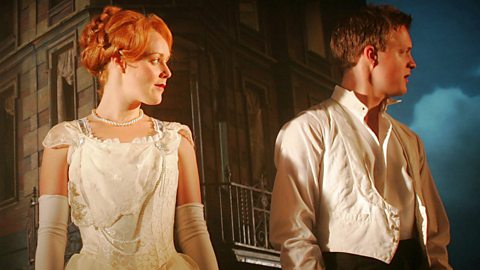
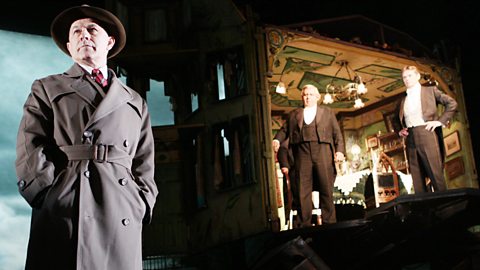
The plot of An Inspector Calls
- An inspector arrives at the Birling house. He tells them how a girl called Eva Smith has killed herself by drinking disinfectant – he wants to ask them some questions.
- The Inspector reveals that the girl used to work in Arthur Birling's factory and he had her sacked for going on strike. Mr Birling refuses to accept any responsibility for her death.
- The Inspector then reveals that Sheila thought that Eva had made fun of her, complained and got her sacked. Sheila is deeply ashamed and feels responsible for the girl’s death.
- The Inspector forces Gerald to confess to an affair he had with Eva. Sheila respects Gerald’s honesty but returns the engagement ring he gave her.
- It is revealed that Sybil Birling had refused to help the pregnant Eva.
- It turns out that it was Eric who got Eva pregnant, and stole money from his father to help her.
- The Inspector leaves. The family ring the infirmary and there is no record of a girl dying from drinking disinfectant.
- Suddenly the phone rings, Mr Birling answers it, to his horror the phone call reveals that a young woman has just died from drinking disinfectant and the police are on their way to question them about it. The curtain falls and the play ends.
Watch: An Inspector Calls – Plot
Jeff Green takes us through the plot of JB Priestley’s play, An Inspector Calls
An Inspector Calls is a play all about responsibility.
It's quite simplistic in its makeup. It takes place in real time, it's all set in one place and there are only six-and-a-half characters in it. Edna here is the half, she's the parlour maid, she's not in it very much. Sorry love.
Now the play starts just after Mr and Mrs Birling have thrown a dinner party to celebrate their daughter Sheila's engagement to Gerald Croft.
He's the really posh one. "What ho!"
Now, everyone's happy and contented, although you get an inkling things aren't quite right. After dinner, Mr Birling has a man-to-man chat with Gerald Croft and his own son Eric. He tells them both that a man needs to look after himself and his family and not worry about anyone else.
Might this have any relevance to what's about to happen? Let's see.
Suddenly a doorbell rings.
And in walks an impressive, serious-looking gentleman by the name of Inspector Goole. Now you might think, judging by how he looks, and from the name of this play, that he's an inspector. But he isn't. He just pretends to be. Or does he?
And that's the major twist to the end of this story. Now for those of you who don't want me to spoil the twist, don't listen to what I just said.
So anyway, in comes Inspector Goole and announces that he's here to investigate the suicide of a young working-class woman called Eva Smith.
When prompted, Mr Birling remembers her. He had fired her for going on strike.
Then Sheila walks in to discover Inspector Goole wants a word with her too. She also remembers Eva, as Sheila got her fired from one of the Birling family's favourite shops. Sheila suddenly feels very guilty about Eva's death.
Inspector Goole goes on to announce that Eva then changed her name to Daisy Renton. Gerald's involuntary reaction reveals that he recognises that name.
Act One finishes with all eyes on Gerald. It's a blooming cliffhanger.
Sheila is upset about whatever Gerald's hiding from her and Eric is revealed to be a drunk.
The wheels are really starting to fall off this nice little family gathering. It's a metaphor.
Gerald reveals that he met this girl and took pity on her. He gave her a place to live and she ended up being his mistress. Sheila, unsurprisingly, is not best pleased.
Eventually, the affair came to an end and he cut Daisy loose. So now he feels guilty too.
Sheila's actually glad to have heard the confession from her fiancé, although Mrs Birling has now got the right hump.
The Inspector then shows a photo of the girl to Mrs Birling.
Mrs Birling pretends she doesn't recognise her but then grudgingly admits she saw Eva, or Daisy, two weeks ago.
So Eva/Daisy asks Mrs Birling's charity for some money to help because she was by then pregnant to a young man who drank too much.
But how did Mrs Birling respond to this impassioned request? Mrs Birling gave her nothing.
Mrs Birling said she could see no reason why the father shouldn't be providing for Eva/Daisy and the baby.
Things are about to get very messy. It dawns on Sheila and the audience that Eric was the father of Eva/Daisy's unborn child.
As if by magic, Eric then walks into the room.
Act Two ends.
Mr and Mrs Birling finally twig that it was Eric who got Eva/Daisy in the family way.
And it all kicks off.
Eric confesses that he met Eva/Daisy sometime after Gerald had ended their relationship. One thing led to another and she became pregnant.
Eric stole fifty pounds from his dad's business to give to her, but Eva wouldn't take it.
So now everyone realises that they played some part in the death of Eva Smith.
Sheila and Eric feel upset and guilty while Mr and Mrs Birling are more concerned about how they can cover up their involvement.
The Inspector, having completed his enquiries, leaves. But not before he delivers a speech about how we should all be responsible for each other.
The narrator suggests this message is aimed as much at the audience as it is at the characters in the play.
Once Goole has left, the Birlings start getting suspicious.
Gerald returns and, with a bit of research, they realise that Goole was a fake. There haven't been any suicides in the area recently.
Mr Birling is delighted and thinks he's off the hook. But Sheila and Eric are still guilty and upset. After all, they did do those horrible things.
Then, right at the end, Mr Birling gets a phone call telling him that a girl has just committed suicide and an inspector is coming over to ask some questions.
Another twist. Brilliant. But then the play ends. No more twists, honest.
Listen: An Inspector Calls – Plot summary
Listen to a podcast about the plot of JB Priestley's play, An Inspector Calls
Carl: Hello, and welcome to the Bitesize English literature Podcast.
Jean: I'm Jean Menzies, author, and ancient historian.
Carl: I’m Carl Anka, I'm a journalist and author.
Jean: We're here today to help you dive a little deeper into some of the texts in GCSE English literature.
Carl: It's worth noting that there will be spoilers in this as we look into each text as a whole. So if you're not quite finished reading, or you're not quite ready for spoilers, just come back later.
Jean: And don't forget that whilst you're in the BBC Sounds app, there's loads of other things you can use to help you with your revision. Full versions of some of the text you might be studying, revision playlists, and other Bitesize podcast series to help with different subjects. We also think it's really important to let you know that in this podcast, there will be discussions of suicide and sexual abuse.
Carl: In this series, we're going all the way back to 1912 and into a fictional town in the Midlands called Brumley to explore JB Priestley's play An Inspector Calls.
Jean: And in this episode, we're going to take a look at the plot of An Inspector Calls to find out the who, what, where and why of the play, and find out about all of the key moments from the story and what An Inspector Calls is all about.
Carl: Alright, it's time to get on my best shoes and polish the cutlery because tonight we're going for dinner with the Birlings. As the play begins, Mr and Mrs Birling are having a dinner party with their son Eric and their daughter Sheila. Sheila’s fiancé Gerald is also there. The family is celebrating Sheila and Gerald’s engagement.
Extract:
Birling: (raising his glass) So here's wishing the pair of you – the very best that life can bring. Gerald and Sheila.
Mrs Birling: (raising her glass, smiling) Yes, Gerald. Yes, Sheila darling. Our congratulations and very best wishes!
Jean: Oh, they seem so happy in this scene, don't they?
Carl: Oh, yes, they do. A nice, happy family dinner. They toast to Sheila and Gerald and then Mr Birling pulls his son Eric, and soon-to-be-son in law Gerald to the side and gives them some advice.
Jean: That's nice of him.
Carl: I wouldn’t quite call him nice. Here's Mr Birling:
Extract:
Birling: (solemnly) …But the way some of these cranks talk and write now, you'd think everybody has to look after everybody else, as if we were all mixed up together like bees in a hive – community and all that nonsense.
Jean: I take that back. He does not seem like a very nice guy
Carl: No. But before Mr Birling finishes his speech about why you should only look out for yourself and your family, an inspector rings the doorbell and walks into the Birling’s house in the middle of their dinner party. He tells them that he's here to talk to them, because earlier on a woman took her own life. The inspector says he wants to ask the family some questions, but he wants to question them one by one. The first person on that list is Mr Birling.
Extract:
Inspector: Do you remember her, Mr Birling?
Birling: (slowly) No – I seem to remember hearing that name – Eva Smith – somewhere. But it doesn't convey anything to me. And I don't see where I come into this.
Jean: So the inspector shows Mr Birling a photo and it turns out he does recognise the woman. Eva used to work in Mr Birling's factory but he sacked her for going on strike for better pay.
Carl: Mr Birling refuses to take any responsibility for the way that his sacking of Eva sent her life into a downward spiral.
Extract:
Birling: (moving) No, leave this to me. I must also have a word with my wife – tell her what's happening. (turns at the door, staring at the inspector angrily.) We were having a nice family celebration tonight. And a nasty mess you've made of it now, haven't you?
Inspector: (steadily) That's more or less what I was thinking earlier tonight when I was in the infirmary looking at what was left of Eva Smith. A nice little promising life there, I thought, and a nasty mess somebody's made of it.
Carl: Well, the inspector doesn't hold back there does he?
Jean: Not in the slightest, he just goes straight to the point. So after questioning Mr Birling, the inspector moves on to questioning Sheila. He reveals that after being sacked by Mr Birling, Eva got a job at a nice clothing store called Milwards. But then Sheila got her fired.
Carl: Why?
Jean: Well, you know, sometimes you walk into a shop and see an outfit on a mannequin and think, wow, I'd look great in that and then sometimes you might try that outfit on in the harsh light of the changing rooms and realise it looks nothing like you thought it would. Well, that's what happened to Sheila. She went to the clothing shop that Eva worked at and tried on a dress. When she saw herself in the dress she didn't think it looked good on her.
Eva was working at the shop and Sheila caught a glimpse of Eva holding the dress up to her body and it looked good on Eva. This brought Sheila’s insecurities out. She thought she saw her smile at the other assistant. So she thought Eva was laughing at her. So she got her fired.
Extract:
Inspector: In fact, in a kind of way, you might be said to have been jealous of her.
Sheila: Yes, I suppose so.
Inspector: And so you used the power you had, as a daughter of a good customer and also of a man well known in the town, to punish the girl just because she made you feel like that?
Sheila: Yes, but it didn't seem to be anything very terrible at the time. Don't you understand? And if I could help her now, I would—
Inspector: (harshly) Yes, but you can't. It's too late. She's dead.
Jean: One thing about the inspector is he's going to tell it exactly as it is.
Carl: He does not care about sparing their feelings at all. So once the inspector is done questioning Sheila, he then moves on to Gerald, Sheila's fiancé. The inspector drops a bombshell when his questioning reveals that Gerald had an affair with Eva Smith.
Carl: Gerald had an affair with Eva Smith when he knew her as a woman called Daisy Renton. Gerald actually made Eva happy when they were together.
Jean: Which the inspector says he found out by reading Eva's diary entries. There will be more on Gerald later. But I think it's worth noting here that there was a big power imbalance in that relationship. And he took advantage.
Extract:
Inspector: She kept a rough sort of diary. And she said there that she had to go away and be quiet and remember ' just to make it last longer'. She felt there'd never be anything as good again for her – so she had to make it last longer.
Gerald: (gravely) I see. Well, I never saw her again, and that's all I can tell you.
Jean: So Gerald made Eva happy for a little while. But as soon as he ended the relationship with her, he left her heartbroken with nowhere to stay. Then he just went back to his life as if nothing had happened.
Carl: Yes. And it turns out that Sheila had already suspected that Gerald had been having an affair. Rather than getting really angry when she finds out the truth, she kind of just respects him for being honest about it. However, she does make it very clear that she is not prepared to accept the husband who has affairs.
Jean: Nope, no happily ever after here. Sheila gives him the engagement ring back.
Extract:
Sheila: We'd have to start all over again, getting to know each other—
Jean: After questioning Gerald, the inspector talks to Mrs Birling, and it's revealed that a few months after Gerald ended things, Eva Smith was pregnant. And after she was in a tough spot when it came to money, she went to the local women's charity to ask for help. And guess who was an influential member of the Women's charity? Mrs Birling, of course.
Carl: Eva went to go and get help for her baby but instead of helping, Mrs Birling used her power and influence to stop Eva from getting any help because Mrs Birling thought Eva wasn’t acting in a way that a working class woman is supposed to act - humble and polite.
Eva called herself Mrs Birling which foreshadows what we will find out in Act Three. The original Mrs Birling (Sheila's mother) did not like the fact that Eva was going around calling herself Mrs Birling. So she refused to help Eva and instead insisted that it was the baby’s father’s responsibility.
Extract:
Mrs Birling: …I blame the young man who was the father of the child she was going to have. If, as she said, he didn't belong to her class, and was some drunken young idler, then that's all the more reason why he shouldn't escape. He should be made an example of. If the girl's death is due to anybody, then it's due to him.
Jean: But then guess who walks in?
Carl: Eric! It turns out that it was Eric who was the unborn baby's father. Eric stole money from his father, Mr Birling, to try and help Eva and the baby. However, when Eva found out, she refused to take it from Eric.
Jean: And a few months later, Eva Smith took her own life.
Carl: Yes, the inspector ends the play with a speech about how each one of them played a part in making Eva's life so much harder than it should have been.
Extract:
Inspector: But just remember this. One Eva Smith has gone – but there are millions and millions and millions of Eva Smiths and John Smiths still left with us, with their lives, their hopes and fears, their suffering and chance of happiness, all intertwined with our lives, and what we think and say and do.
Carl: When the inspector leaves, Sheila starts crying. Mrs Birling collapses into a chair. Eric is caught in deep thought and Mr Birling pours himself a drink.
Jean: But then Gerald comes back in the same room. It turns out that he went to speak to a police officer he knew. He discovers there’s no one in the local police force called Inspector Goole.
Carl: Inspector Goole is a play on words. Ghoul - like a ghost.
Jean: They call the infirmary and find out that woman hadn't died that night, either.
Carl: The Birlings and Gerald then begin to start talking and they realise why they all did the things they did. Nothing the inspector said proves they actually knew the same Eva Smith.
Jean: Eric and Sheila are thinking seriously about everything that happened, because they do seem to actually feel some responsibility. Mr and Mrs Birling’s response is much more self-centred, and they are relieved, because if Eva Smith didn't die, there's no chance of the story ruining their reputations. But then…
Extract:
Birling: Yes?. . . .Mr Birling speaking. . . .What? - here-
Birling: That was the police. A girl has just died – on her way to the Infirmary – after swallowing some disinfectant. And a police inspector is on his way here – to ask some – questions –
Jean: What an ending!
Jean: Thanks for listening to this episode of the Bitesize English literature podcast. We hope this has been helpful for you and your revision. Don't forget you can listen back to this or any of the episodes at any time to help your revision on BBC Sounds.
You can listen to the whole Bitesize GCSE English Literature podcast series about An Inspector Calls on BBC Sounds.
Act One
- Before the play begins, Priestley gives detailed instructions on how the play should be staged. The action takes place in a single room with few adjustments needed during the performance. The stage directions specify that the house is “not cosy and homelike” and the lighting needs to become “brighter and harder” once the Inspector arrives. The first of the three acts opens with the Birling family and Gerald Croft celebrating the engagement of Sheila Birling and Gerald.
- As it is a happy occasion, Mr Birling takes the opportunity to make a speech. During the speech he reveals how happy he is that Sheila is marrying Gerald because Gerald’s parents are wealthy business owners. It is clear that Mr Birling feels this marriage will be to his advantage; he boasts that he is to be considered for a knighthood.
- It is important to realise that the audience of 1945 would pick up on the fact that a lot of what Mr Birling says is incorrect. He states how war will never happen and that the Titanic is unsinkable. This would indicate to the audience that what Mr Birling says is not to be trusted. It might also alert them to a few other clues that Priestley gives in this opening scene that things are not as positive as they might appear in the Birling house. Eric Birling is distracted and a little drunk, while Sheila teases Gerald about him neglecting her last summer.
- During the speech, Mr Birling suggests that “a man has to make his own way”. At this precise moment, Inspector Goole arrives.
- The Inspector tells the family that a girl died in the infirmary two hours ago. She took her own life by drinking disinfectant. The family are shocked by this news but don't see how they could be involved. The Inspector has a picture of the girl and a letter and diary she had written. He only ever shows one person the picture at a time – this is an important detail for later.

- He reveals the girl's name – Eva Smith, and that she used to work in Mr Birling's factory. Mr Birling had Eva sacked as she was the ringleader of a group of workers who had asked for higher pay. Mr Birling still can’t see how he has anything to do with Eva’s death. The Inspector points out that her being sacked could be the beginning of a chain of events that led to her suicide, but Mr Birling is still not convinced.
- The Inspector explains that Eva Smith had no family to turn to and was out of work for two months after being sacked by Mr Birling. He then turns his attention to Sheila who has been deeply affected by the news of the girl’s suicide. He asks if she remembers making a complaint about a worker at the department store, Milwards. She does and then he shows her the photograph to confirm the girl’s identity. Sheila is horrified when she finds out that her complaint led to Eva being sacked for a second time.
- Sheila gives a full and honest account of what happened in the store, admitting that she thought Eva had smiled when she tried on a dress that didn’t suit her. Sheila is very ashamed of her behaviour.
- The Inspector says that after being sacked from Milwards, Eva Smith changed her name to Daisy Renton. On hearing this, Gerald is shaken and privately Sheila presses him for more information. He admits that he was having an affair with Daisy over the summer and that was why he didn’t see Sheila. The first act ends.
Act Two
- Act Two begins with Gerald and Sheila discussing the affair. Gerald is initially hesitant to come clean but eventually tells the truth. Although Sheila respects him for his honesty, she returns his engagement ring. Gerald had picked up Daisy in a bar and had looked after her, giving her money and accommodation. While Gerald was fond of Daisy, she had much stronger feelings for him and was devastated when Gerald ended the relationship.
- The Inspector tells us that after the affair with Gerald, Daisy went to live by the sea for two months – this was when she kept the diary he had found.
- Attention then turns to Mrs Birling, who is revealed to be a prominent member of the Brumley Women's Charity Organisation. She has kept quiet about the fact that just two weeks earlier Daisy had approached the charity seeking help. Daisy had called herself Mrs Birling when she introduced herself to the charity, Mrs Birling did not like this and sent her away.

- The Inspector continues to question Mrs Birling and it turns out that Daisy was pregnant. Mrs Birling claims that the man who got her pregnant should be made an example of. Sheila realises what has happened by this point and begs her mother to stop talking; Eric enters the scene and Act Two ends.
Act Three
- Mrs Birling looks very stupid after Eric admits that it was he who got Daisy pregnant. Like Sheila, he is very ashamed of his actions and is honest about his involvement with Daisy. He tells the Inspector that he drinks heavily and how, during a night out, he met Daisy. He admits that the first time they met he walked her home and pressured her into letting him into her lodgings. He slept with her that evening and on a further evening. When he next met Daisy, he found out that she was pregnant.

- They both knew that they weren't in love and marriage wasn't an option but Eric wanted to help by giving her money. She refused to accept the money when she found out Eric had stolen it from his father's business.
- The family are distraught by this point and are arguing amongst themselves. The Inspector interrupts and makes a speech about how if we are not responsible for each other, there will be terrible consequences.
- The Inspector leaves and Gerald returns after a walk outside. He met a police officer and found out that there was no Inspector Goole on the force. They also begin to wonder if the girl mentioned to each of them could have been “four or five different girls”, suggesting that the whole evening could have been a trick.
- Gerald rings the local infirmary and discovers that no girl who had died by drinking disinfectant had been admitted. Mr and Mrs Birling and Gerald are excited by the idea that they may not be to blame. Eric and Sheila are aware that it makes no difference whether or not the Inspector was real – they still behaved badly.
- Just as Mr Birling is mocking the Inspector and is celebrating that he is off the hook, the phone rings. Mr Birling answers and to his horror it is the police. They inform him that a girl has just died after drinking disinfectant and a police officer is on their way to ask the family some questions. The curtain falls and the play ends.
Test yourself
Further study
Watch: An Inspector Calls (2015) video
The mysterious 'Inspector Goole' interrupts a wealthy family's family party to tell them a young woman died of suicide that night. But what's that got to do with them?

Great Lives: JB Priestly (2011) audio
Comedian Barry Cryer chooses the playwright JB Priestley as someone who inspired him. With Martin Wainwright.

Priestley's Postscripts (2010) audio
Martin Wainwright explores the Second World War broadcasts of the influential playwright JB Priestley.

More on An Inspector Calls
Find out more by working through a topic
- count2 of 5

- count3 of 5