The plot of Journey's End
- Officer Osborne – second in command of C Company – and Commanding Officer Hardy are in a A shelter for soldiers in the trenches, made by digging a hole in the ground and covering it with a roof.. Hardy and Osborne are from different companies. They discuss the Commanding Officer of C Company, a man called Dennis Stanhope. While they converse a new young officer, Raleigh, enters the dugout. We find out that he too has known Stanhope in the past.
- Stanhope enters the scene. He asks for a drink and shows little sympathy for an officer’s complaints of neuralgia.
- Stanhope and Osborne discuss the possibility of a German attack in the following days.
- The Colonel enters the scene and tells Stanhope he thinks Raleigh and Osborne should participate in a raid on the German line the next day.
- When the officers are told about the raid they all react differently. Young Raleigh is enthusiastic about his fate. The Colonel promises them the Military Cross for bravery once it is over.
- After the raid, we find out that Osborne and six other men have been killed. A German soldier is taken prisoner and interrogated.
- Raleigh has changed his attitude. He has lost his Someone who has high or noble goals and bases their behaviour on these ideals, even if they are unrealistic.belief that it is a A special right, advantage, or immunity available only to a particular person or group. to fight for one’s country. He does not join the post-raid celebratory dinner.
- The Germans attack in the final scene. Raleigh lies dying with Stanhope by his side. The dugout collapses as Stanhope leaves the stage. The ending is Something that could be interpreted in more than one way. and we are left uncertain about the fate of the remaining characters.
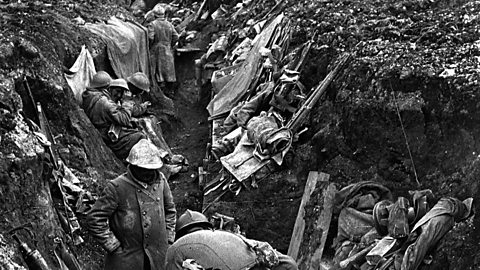
Journey’s End is set in the vicious trench warfare of World War One.
It is about how men deal with extreme fear.
Stanhope and Osborne are at the heart of the play.
Stanhope is a brave and a strong leader. He is furious that Raleigh, an old friend who glorifies Stanhope as a “hero figure”, has found a way to join his unit.
You see, Stanhope is in a relationship with Raleigh’s sister Madge, and he's scared that Raleigh will write home and tell her about Stanhope’s drinking.
Osborne, Stanhope’s older second in command, is a father figure to him. Osborne tries to tell Raleigh that Stanhope has suffered the psychological effects of war, but Raleigh doesn't understand. He believes in the kind of 'glorious war' portrayed in the recruiting propaganda at home.
Stanhope admits he drinks too much whisky and tells Osborne it's to cope with trench life, especially a terrible battle where men had to shelter under the dying bodies of their comrades.
Osborne and Raleigh discuss life outside the war. They realise that Germans are just ordinary people.
Osborne describes the sheer madness of war, telling a story of how a man was shot trying to cross 'No Man’s Land', but how the German commander allowed his comrades to carry him back to safety.
A raid is ordered to capture a German soldier who might provide useful information.
Stanhope tells his colonel that he thinks the daylight raid is madness, but the colonel insists. Raleigh will join Osborne on the raid.
Osborne accepts his fate calmly but he and Trotter, a working class brave soldier, agree not to tell Raleigh too much:
There’s no need to tell him it’s murder
Raleigh is unaware of the extreme danger ahead, seeing it boyishly as “frightfully exciting”.
Only four of the 10 soldiers in the raid return. Osborne is killed and Raleigh wounded.
Stanhope is furious when he realises the colonel only cares about the information the captured German soldier might reveal, not for the killed and injured men.
He is angry too that Raleigh cannot pull himself together, but Raleigh explains that he is grieving:
Osborne’s – lying – out there…
As he acknowledges his own grief for Osborne, Stanhope is distraught:
The one man I could talk to as man to man – who understood everything…
The scene shifts to morning and the battle begins. The Sergeant Major tells Stanhope that Raleigh has been badly injured by a shell:
It’s broke ’is spine, sir.
Raleigh is dying.
Could we have a light? It’s – it’s so frightfully dark and cold…
Stanhope tries to chat to Raleigh, but there is no reply. He is called to leave as the battle worsens.
As he goes, “the whine of a shell rises to a shriek and bursts on the dugout roof. The shock stabs out the candle-flame.”
The dugout collapses on Raleigh’s dead body and becomes his tomb.
Act One
- The play opens in a dugout in the British trenches in Northern France. The action begins on the evening of Monday 18 March 1918 and continues over three days. It ends at dawn on Thursday 21 March 1918.
- Captain Hardy is about to be relieved by a Captain Stanhope. The play begins with Hardy and Stanhope’s second in command – Osborne – discussing what Stanhope is like. Osborne and Stanhope are the main characters for the rest of the play.
- After Hardy leaves, a new young officer – Raleigh – enters. Raleigh has managed to get himself placed in C Company because he knew Stanhope at A private, expensive, fee-paying secondary school, usually a boarding school. Public as in not run by the Church.. Also, Stanhope has been in a relationship with Raleigh’s sister, Madge.
- Osborne tries to hint to Raleigh that Stanhope is a changed man from the one he might remember. But Raleigh fails to understand and seems to have an idealistic picture of Stanhope as a mythical hero figure. It is also clear that Raleigh is excited and enthusiastic about being on the front line. His youthful energy and exuberance already seem in contrast to the more experienced officers.
- When Stanhope enters it is clear he is shocked and uncomfortable at Raleigh’s presence. We find out that he fears Raleigh will write and inform Madge that he has become an alcoholic and – despite Osborne’s advice to the contrary – he threatens to censor Raleigh’s letters.
- Through a conversation with Osborne we discover that Stanhope’s addiction was caused by the terrible realities of trench life.
Act Two
Scene 1
- Early on Tuesday morning Osborne and Raleigh discuss their past lives before the war. They talk about rugby and how slowly time passes in the trenches. Poignantly, they reflect on how the Germans are just normal decent people.
- Stanhope tells his officers that a captured German soldier has revealed that an attack on their men is planned for two days’ time.
- In World War One it was normal practice to check and sometimes To examine something and decide whether to cut out parts which may be offensive. soldiers’ letters home, but officers’ letters were usually allowed through unchecked. However, Stanhope – because he is so worried about Raleigh revealing his alcoholism to his sister – insists on checking his letter home. On reading it he finds that Raleigh has only the highest praise for Stanhope, describing him to Madge as “the finest officer in the battalion and the men simply love him”. Stanhope seems to feel ashamed at his initial mistrust.
Scene 2
- The Colonel arrives to inform Stanhope that Raleigh and Osborne will participate in an imminent raid on the Germans.
- An officer called Hibbert tells Stanhope that he is suffering from neuralgia – shooting facial pain – and can no longer cope. Stanhope will not allow him to go sick and threatens execution for The act of leaving a post without permission, usually with no intention to return. In the army desertion is illegal. if he does.
- Eventually Stanhope – using the powers of persuasion and leadership that the officers respect him for – convinces Hibbert to stay.
- Osborne seems resigned to his fate, but he and Trotter express their disapproval of the timing of the raid. Raleigh on the other hand is unaware of the extreme danger and looks forward to the excitement of battle.
Act Three
Scene 1
- It is obvious that Stanhope too thinks a daylight raid is ridiculous and dangerous, but the Colonel is adamant. He tells Stanhope, "It’s no good getting depressed.” The audience gradually begin to question just how much the army superiors really care about those on the front line.
- Again, Osborne talks acceptingly about the plans and Stanhope insists – unconvincingly – that all will be well.
- We see Osborne and Raleigh quoting a passage from Alice in Wonderland in the moments before the raid. They are trying to keep calm, but admit they are nervous and have “a sort of empty feeling inside”.
- A young German soldier is captured in the raid, but Osborne and six other men are killed. Raleigh is wounded.
- Stanhope finds it difficult to hide his contempt for the Colonel’s apathy about their deaths.
Scene 2
- Later that evening the officers are having a post-raid celebratory dinner. Stanhope seems in a particularly bad mood. He has a drunken argument with Hibbert and gets angry with Raleigh for not attending the dinner.
- Raleigh explains that he is grieving for Osborne.Stanhope shows his devastation at Osborne’s death. In an emotional outburst he describes his friend as "the one man I could talk to as man to man – who understood everything”. We realise that his drinking and jovial dinner chat has all been to cover up his grief.
Scene 3
- This final scene takes place at dawn on Thursday morning. It is pitch dark and there is silence apart from “the distant mutter of the guns”. Stanhope is woken by Private Mason – the cook – and is drowsy and cold.
- There is tension in the dugout as the men and the audience wait for the attack.
- It is finally here, having first been mentioned two days earlier. Hibbert is frightened and reluctant to go out, but with encouragement from Stanhope and Mason he leaves to fight.
- The battle begins. The Sergeant Major arrives to tell Stanhope that Raleigh has been badly injured – his spine is broken. Raleigh is carried into the dugout and Stanhope gets Osborne’s bed ready for him.
- It becomes clear that Raleigh is dying. Stanhope stays by his side, comforting him. He attempts conversation, but there is no reply.
- Stanhope is called to leave as the battle intensifies. As he ascends the steps to the battle the dugout roof collapses, with Raleigh’s body inside.
- The fate of the other characters is left ambiguous, but we assume they all die.
Test yourself
Further study
World War One: The global conflict that defined a century. collection
The First World War was the first truly global conflict – the battle raged not just in the trenches of the Western Front but in Africa, the Middle East and Asia.
World War One. collection
A collection of programmes relating to World War One

Bitesize: World War One
A collection of articles covering World War One as part of Key Stage 3 History (Environment and Society).
More on Journey's End
Find out more by working through a topic
- count2 of 5

- count3 of 5

- count5 of 5

