Which Anglian Water areas are worst for pollution?

 Shariqua Ahmed/BBC
Anglian Water has been accused of "not taking polluting seriously" after it registered 12 serious incidents in 2025 and was rated "requires improvement" by regulators for the fifth year in a row.
The company, which supplies water and sewerage services across the East of England, parts of the East Midlands and Lincolnshire, admitted it had "more to do", but said bathing waters in its area were their cleanest in a decade.
Scientists and campaigners said they were still seeing high levels of pollution in the region's waterways, from the River Great Ouse in Bedfordshire to the River Deben in Suffolk.
They are calling on Anglian Water – which reported operating profits of £636m this year – to ramp up investment.
So where is the pollution hitting hardest, and what impact is it having?
How bad is it?
 Deben Climate Centre
The company experienced 368 pollution incidents in 2025, 12 of which were classed as "serious" category one or two cases.
It was not alone. Eight of England's nine water companies were rated as "poor" or "requiring improvement" by government regulators.
Retired scientist David Findley leads the water quality programme for the campaign group Deben Climate Centre in Suffolk. He said that while some river pollution came from farm or industry run-off, much of it came from Anglian Water treatment works.
"One reason is 'combined storm overflows' at the sewage works – when it's heavy rainfall, water and sewage vent straight into the river," he said.
"The other is when pumping stations fail. Basically, raw sewage is pumped straight on to the land or into the river or estuary."
The company said it was investing more than £2bn in environmental schemes between 2025 and 2030.
As a result, there was a 62% reduction in spills from storm overflows in 2025 from the previous year and a 16% reduction in the number of pollution events compared with 2024, a spokesperson said.
What is the impact?
 Stephen Huntley/BBC
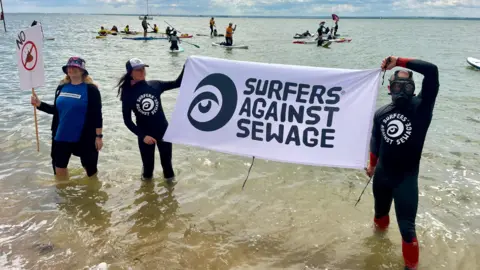
Surfers Against Sewage has long raised concerns about people getting sick due to water pollution.
The campaign group said there were 501 sewage alerts at Anglian bathing waters in 2025, which a company spokesperson described as "broadly correct".
The areas most affected were Holland-on-Sea in Essex, Southend, Cleethorpes in North East Lincolnshire, and Gorleston in Norfolk.
Findley said many people liked to swim in the estuary at Woodbridge, but they were at risk of becoming ill when there were sewage spills.
Another "big, big issue" was phosphate pollution, which creates algae growth. This was "probably not lethal, but it is not good for wildlife and aquatic life", he added.
Georgia Waye-Barker, from Norfolk Rivers Trust, agreed. "Chronic issues like elevated phosphate levels build up subtly over time, degrading entire aquatic ecosystems," she said.
An Anglian Water spokesperson said: "While we have more to do, our region's rivers contain 80% less phosphate than they did 30 years ago, and we've taken 340 storm overflows out of operation permanently.
"Our bathing waters are the cleanest they have been since regulations were introduced in 2015, with 96.3% of designated bathing waters rated 'good' or 'excellent' – the highest proportion in England."
Where was pollution worst?
 Environment Agency
Anglian Water said its most serious pollution events in 2025 took place in:
- Dry Drayton
- East Harling
- Godmanchester
- Gunthorpe
- Lowestoft
- Ormesby
- Rockingham
- Rushden
- Stifford
- Thundersley
- Torridon
- Uttons Drove
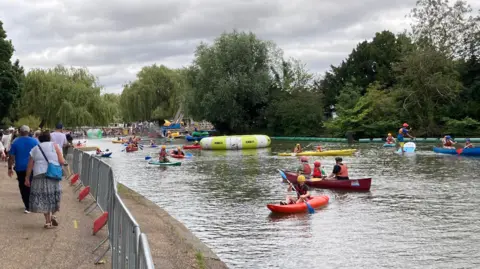
However, Alan Horn, who chairs Bedfordshire Great Ouse Valley Environmental Trust, said he saw "high levels [of pollution] everywhere" in the River Great Ouse.
"Out of the 20 sites we monitor on a monthly basis, two were at the E. coli level considered to be 'safe'," he told the BBC.
"In April, 10 sites had... levels in excess of 10,000 coliforms, when 900 is the safe level."
E. coli bacteria is found in the intestines of humans and animals. There are many different types, and while some are harmless, others can cause a variety of diseases.
Anglian Water has previously said E. coli could also come from "agricultural and urban run-off and local animal waste" and it was "highly unlikely" that the sewage plant was its only source in the Great Ouse.
Horn was sceptical about the company's promises to improve and said it "doesn't take polluting seriously".
"They will still be spilling sewage in the river for the next four to five years," he predicted.
Meanwhile, Waye-Barker called for "greater investment in upgrading sewage infrastructure... especially as population growth, prolonged droughts and increasingly severe downpours put further pressure on these systems".
But the Anglian Water spokesperson said it was making progress on the issue, adding: "We've halved the number of dry-day spills for the equivalent period (January-May) two years running, moving from around 2,000 dry-day spills in 2024 to around 1,000 in 2025 and around 500 this year."
What is Anglian Water doing?
 Alex Pope/BBC
While the company received two red (significantly below target) and one amber (target missed) ratings, according to its most recent Environment Performance Assessment, it also received three green (target met) ratings for sludge disposal, self-reporting pollution, and delivering environmental projects.
Anglian Water said it was focused on reducing "the three primary root causes of pollutions", which accounted for 82% of its pollution in 2025.
They are blockages of foul sewers, power supply failures to pumping stations, and structural failure of underground systems.
Its action plan to reduce pollution has promised "collaborative working" and "continuous learning".
Chief executive Mark Thurston was denied his £1.05m bonus after thousands of tonnes of raw sewage entered the River Mardyke in Grays, Essex, last year, killing more than 4,700 fish.
Findley said his team had "a very good relationship with our local Anglian Water group", but he believed investment was "too slow" and sanctions such as fines were "not cutting in".
Like Horn, he would like to see much more robust monitoring and accountability from the government and the water companies.
The government says that environment watchdogs have "pooled" their data for the first time, "which leaves nowhere for underperforming companies to hide".
Environment Secretary Dame Angela Eagle has previously said she was "demanding answers from the companies that are failing" and would be "shining a spotlight on the worst offences around the country".
 Deben Climate Centre
Do you have a story suggestion? Contact us below.
Follow East of England news on X, Instagram and Facebook: BBC Beds, Herts & Bucks, BBC Cambridgeshire, BBC Essex, BBC Norfolk, BBC Northamptonshire or BBC Suffolk.