Mayor will be elected to help run Norfolk and Suffolk

 Suffolk County Council
A mayor will be elected to run Norfolk and Suffolk from May 2028, it has been agreed.
Suffolk County Council's cabinet renewed its consent to establish the Mayoral Strategic Authority (MSA) for the two counties during a meeting at 14:30 GMT.
In October, its counterpart in Norfolk had already made that same decision on plans for the strategic authority which would oversee transport, skills, housing and economic growth.
Renewed consent was required following changes to the government's mayor election timetable and the national devolution framework, and leaders of both councils said they looked forward to having "greater control" over local decisions.
The new mayor for both counties will have £1.1bn in funding over the next 30 years to make use of, which equates to about £37m a year.
Michael Hadwen, Reform UK leader at Suffolk County Council, said the decision had "reaffirmed our commitment to giving people in Suffolk a stronger voice in the decisions that affect their everyday lives".
"Our incredible county is home to many nationally important industries – from the ports and logistics sector to clean energy, advanced manufacturing and agriculture," he added.
"Cabinet's decision today gives us the opportunity to turbocharge economic growth and improve transport and infrastructure in our region."
 Joao Santos /LDRS
Norfolk's cabinet met at the end of October, where it gave its renewed consent, but afterwards, Hadwen said he needed more time to ensure that government funding would be split equally between the two counties.
Paul Simon, head of public affairs and strategic communications at Suffolk Chamber of Commerce, said it was "great news" that the county council had agreed to go ahead with the deal.
"Suffolk County Council's administration has absolutely made the right decision in backing the government's devolution deal to create an East Anglia Mayoral Strategic Authority," he said.
"In so doing, it has ensured that our county and our region is as best placed as possible at this stage to take advantage of the greater funding and influence that comes with these arrangements."
He added that a devolved framework would offer "the potential for our businesses and communities to assume great control and influence".
 Vikki Irwin/BBC
Andrew Stringer, leader of the Greens, who are the official opposition to Reform at the county council, said he was concerned the deal would not provide any benefit to Suffolk communities.
"The Reform UK administrations at Norfolk and Suffolk County Councils are keen to portray themselves as having great success for the devolution deal they have agreed with the government," he said.
"However, from what we can see, the deal does not include devolving down any powers from central government.
Local transport, economic development, skills, public health and protection and the environment are all powers that have been taken from local councils, so this means that rather than devolving power closer to local communities, it will be taking them further away, to a mayoral authority which covers two counties."
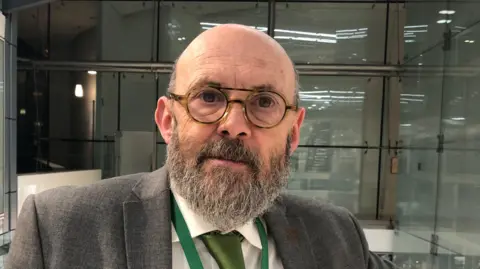
Analysis by BBC Suffolk's political reporter Vikki Irwin
A devolution deal and a combined mayoral authority for Norfolk and Suffolk have been on the cards for over a decade.
In the past, however, it failed to materialise, always falling at the last hurdle.
In 2016, infighting between all counties meant Suffolk missed out on a devolution deal under the banner of a Norfolk, Suffolk and Cambridgeshire mayoral authority.
In the end, Cambridgeshire went ahead alone and has had a mayor and devolution deal since 2017.
In 2024, a deal for just a Suffolk mayor was close to being signed by the Conservative government, but it failed to put ink to paper before the general election.
Now, under the Labour government and the devolution white paper, Norfolk and Suffolk have been brought back around the table, and Suffolk's sign-off today will be the most significant change to the local government structure since the 1970s.
The main push behind the councils committing to this next step might have something to do with the money a devolution deal and mayor will unlock.
This deal could bring in £1.1bn in extra funding for the next 30 years.
The direction of central government must also be noted. It has been giving increasing powers and continued additional investments to mayoral areas, and that is unlikely to change.
Suffolk and Norfolk need to be in it to win it.
Do you have a story suggestion for Suffolk? Contact us below.
Follow Suffolk news on BBC Sounds, Facebook, Instagram and X.