Market and town halls: Historic sites being left to ruin

 Historic England
Historic buildings dating back to Anglo-Saxon and Roman times make up key landmarks across the West of England, attracting thousands of tourists every year.
But maintaining them can be expensive and two new sites in our region have been placed on Historic England's Heritage at-risk register.
Across England, there are close to 5,000 buildings, places of worship, archaeological sites and protected wreck sites on the register, which shows they are at risk of neglect, decay or inappropriate change.
Some venue leaders have also spoken about their attractions being placed on the register. Read our round-up of the West of England sites below.
Gloucestershire
Historic England said investment was needed to protect a Grade II* listed historic building which is a hub in the community.
Dursley Town Hall has problems with the roof, dormers and rainwater systems which need to be addressed to protect the building.
Built in 1738, the hall remains an important landmark in the town.
With an open level at the bottom, it is used for markets and events as well as rooms to hire above.
John Rubin, vice chair of the Town Trust Committee, said having the building added to the register means it had been "formally recognised as a historic asset in need of preservation".
He said the status will "help raise awareness, attract funding, and encourage community involvement to ensure the building's architectural and cultural significance is protected for future generations".
 Historic England
There is some good news for Gloucestershire's heritage sites.
The Temple of Vaccinia in Berkeley, where Dr Edward Jenner performed the first vaccinations against smallpox in 1796, has been removed from the register after being placed on it in 2025.
It reopened in May following major restoration work and access improvements funded by The National Lottery Heritage Fund.
Dr Jenner's House and Museum director, James Rodliff said seeing the hut removed from the register was a "proud moment for our small museum".
He said the restoration had been a "collective effort, bringing together our staff, volunteers and trustees with skilled craftspeople, specialist advisers and generous supporters".
Bristol
 Historic England
The Corn Exchange, which is in need of £5.5m of repairs, has also been added to the list.
The building is home to St Nicholas Market which has 63 independent traders who sell food, clothing and arts and crafts, and pay fees to the council to trade there.
It was built in 1743 as a meeting place for the city's merchants, with the courtyard covered roof added in 1872.
Councillor Andrew Brown at Bristol City Council said the site's inclusion on the register "highlights the challenges facing The Exchange", but that it should help "strengthen the case for investment to support the market and bring underutilised areas of the building into regular use".
Council leaders have committed to invest £550,000 towards the repairs and improvements to the building.
"We have set out a clear ambition to protect what makes the market special while ensuring it continues to evolve and thrive," said Brown.
He said the plans included "creating a stronger and more sustainable market, supporting traders, improving the visitor experience and making the most of its unique heritage".
 Historic England
Wiltshire
 Jaggery/Geograph
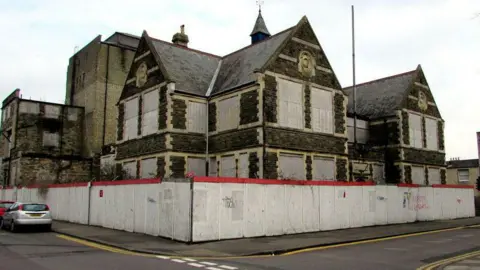
Wiltshire has 152 listings on the Heritage at-risk register, with one being the Grade II* listed former Mechanics' Institute in Swindon.
Built in the 1850s, it once housed a library and theatre and provided health services to Great Western Railway Workers. It closed 50 years ago and has remained derelict ever since.
Bob Wright, from Swindon Heritage Preservation, said the building was the "sore thumb" of the town.
"If you go into the centre of Swindon and you have a look at built Victorian heritage, you will find the only building not being worked on is the Mechanics' Institute," he said.
Wright also said the trust had completed a viability assessment and proposed the building be used "flexibly" for things like community events and weddings.
"We need Swindon to get back to where it was in the early 70s when we had so many good buildings, so many good things to see and do," he added.
Somerset
Somerset Council owns No. 9 Fore Street in Chard, which forms part of the Grade I-listed group associated with Waterloo House and Manor Court House.
The property - which is leased to South West Heritage Trust - remains on the Heritage at Risk Register while essential repairs and a strategy for viable long-term reuse are being developed, a spokesperson for the council said.
The leaseholder, along with support from Somerset Building Preservation Trust, is working to ensure the building is wind and weather tight and safe and will assess its historic development and potential future uses.
"Our conservation officer and Historic England are in regular discussions with the trusts.
"Essential repairs, restoration and a viable long-term use are needed to enable its removal from the register.
"Once the feasibility work is complete, a listed building consent application will be submitted to Somerset Council, followed by a formal consultation with Historic England," the spokesperson added.
Follow BBC Gloucestershire on Facebook, X and Instagram. Send your story ideas to us on email or via WhatsApp on 0800 313 4630.