Man wanted hotel firebomb to kill migrants - court

 BBC
An alleged far-right extremist accused of plotting to attack a hotel housing asylum seekers in Hull wanted "to kill as many of the occupants as possible", a court has heard.
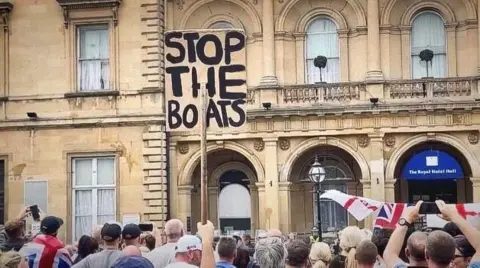
Mikka Lee Anderson, 24, of Morpeth Street, Hull, tried to recruit an accomplice to attack the Royal Hotel in February, but the defendant was arrested after the would-be accomplice reported him to police, Newcastle Crown Court was told.
The prosecution said Anderson had planned to attack the hotel using petrol bombs.
The defendant denies preparing an act of terrorism including by manufacturing Molotov cocktails, conducting reconnaissance at the hotel and possessing knives and other weapons for terrorist purposes.
Opening the case, prosecution barrister Adam Birkby told the court Anderson had apparently lived "a normal, everyday life", living in a flat with his partner and working in a factory.
However, he said: "Behind this veil of normality, the Crown says he was immersed in extreme right-wing ideology, which fuelled his planning and preparation for an act of terrorism."
Weapons stash
The prosecution said Anderson admired Hitler and referred to himself as a Nazi.
Anderson was arrested after meeting the associate, who cannot be identified for legal reasons.
He is said to have outlined to the associate "his plan to attack the Royal Hotel by the city's railway station, and to kill as many of the migrants who were housed inside it as possible".
The hotel is no longer used to house asylum seekers.
The man he met reported his concerns to police, saying it was his duty to prevent anybody being killed in an act of terrorism, the court heard.
During a search of Anderson's home, police found a stash of weapons including knives, a crossbow and petrol bombs, as well as camouflage clothing and a gas mask.
Officers also examined his phone and found social media posts and messages he had shared with "like-minded individuals", Birkby said.
The prosecutor added: "Anderson considered non-white people to be a societal pest, which needed to be dealt with."
In police interviews, the court heard Anderson had denied being a Nazi or a racist, claiming the messages and posts found on his phone were posted in anger or were just him showing off.
The trial continues.
Listen to highlights from Hull and East Yorkshire on BBC Sounds, watch the latest episode of Look North.
Download the BBC News app from the App Store for iPhone and iPad or Google Play for Android devices