'We all need data, but do we need the largest data centre in Europe here?'

 Digital Reef
North Ockendon in Havering, east London, is right in the middle of London's green belt on the edge of the capital. But it might not be green belt for much longer if developers have their way.
These fields are the proposed site for a huge data centre campus - one of the largest in Europe.
Developers Digital Reef say it would create jobs and be the most sustainable in the world, but the locals don't want it and say it would destroy their lives.
And this development shows the dilemma and many of the issues around data centres. They are necessary for much of modern life. But where do you put them and at what cost?
Danny Leach, who lives locally, says his property "is going to be like a bull's eye on a dartboard" if the plans get the go-ahead.
"There will be the construction for the next eight to 20 years. There will be noise, there's going to be another thousand vehicles a day they're saying," he says.
"There will be disruption, the mess, and then, obviously, when it's operational, the background noise the data centres make and the amount of electric it uses - we already have two power cuts a month here.
"We all need data, but do we need the largest data centre in Europe in this location?"

Graham Ford is also against the proposed development.
"This is rural. This is country. Leave it as it is," he says.
Emma Edmonds adds: "Most people absolutely don't want this.
"It's sacrilege to just build something like that here. It's not the right place at all."
Meanwhile, Ian Pirie, from the local Friends of the Earth, is critical of the planning process so far, saying it has been "very undemocratic".
"They have not involved people," he says.
Demand for data centres is increasing, partly driven by AI needing more processing power.
At the moment, there are about 477 data centres across the UK and construction researchers Barbour ABI think that is going to increase by about 100.
Most of them will be in London and the South East.
The planning data suggests 28 of these new data centres will be within the Thames Water Catchment area, with 14 in Slough which already has the most data centres in Europe.
There are concerns about the amount of electricity and water data centres use.
A report for the Greater London Authority, London's Data Centre Future Growth Forecasts and Strategic Insights, outlines the challenges facing new data centres.
"Energy is the single most critical constraint on London's data centre growth," it says.
"Transmission grid capacity limitations have emerged particularly in west London, and new connection timelines for data centres may range from seven to 13 years, as compared to three to seven years in other European markets."
The report says water consumption is another "major consideration".
"A 100MW hyperscale data centre in the UK can consume up to 2.5 billion litres of water annually, equivalent to the needs of approximately 80,000 people, driving the shift toward closed-loop, air, and liquid immersion systems to reduce reliance on potable water," it says.
Data centres in London currently use about 5% of drinkable water, that is expected to rise to 7%.
The report also says: "High land costs and competition with housing and other industrial sectors make most plots in inner London and zone 2-3 challenging and may drive new development towards the edges of London."
It warns growth could put more strain on water systems.

The data centre industry is well established in London, but while it once prioritised security and secrecy, that is changing as operators become more open about why their services matter.
Mark Pestridge, chief executive of Telehouse, which operates data centres in London, says the centres underpin many of the services people rely on every day from streaming platforms to train timetables.
At the company's site in Canary Wharf, I asked how long would it take for people to notice if a data centre went down.
"I think they'd notice within minutes," he replied.
He says the industry needs to do more to explain its importance and there are "some myths we need to bust" around water and energy usage.
"In this building that we're in today, which is Telehouse South, we work on a closed loop system, which is a bit like your radiator or a fridge. The water just goes round and round, rather than ever taking water out of the system," he says.
"On electricity usage, I think we do use a lot of electricity, but I genuinely believe that the data centre is one of the most efficient as possible about how we use that electricity."

Some academics have urged caution over the pace of expansion.
Liz Stephens, professor of climate risks and resilience at the University of Reading, thinks the amount of extra water needed for data centres could potentially negate any extra capacity from new reservoirs.
"Thames Water had been trying to predict demand over the next 10 years," she says.
"They've estimated that about 30% of that increased demand is coming from the growth in data centres.
"And I think they've already admitted that they're underestimating the demand that's happened so far from those data centres."
But Matt Evans, from Tech UK, says the industry's environmental impact is often misunderstood.
"So data centres use a lot of energy, there's no getting around that, but the energy that they use is now nearly 100% carbon-free or renewable energy," he says.
"In terms of water, there's a lot of misunderstanding because a lot of that data comes from the United States which has a really different regulatory environment.
"Data centres in the UK use about 0.2% of our non-domestic, non-household water.
"So that's quite a small amount and the sector is determined to bring new technologies that are more efficient so that we use less water in new data centres going forward as well."
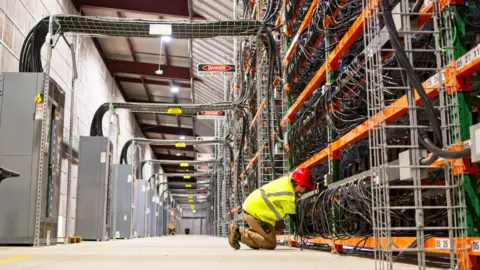 Getty Images
The draft London Plan, which guides councils on planning, says data centres in suitable locations should be supported in principle.
However, schemes should only be given the go-ahead if water and electricity capacity is available.
Sites allocated for housing should not be used and green belt land should only be considered if there are no brown field sites available.
"London is home to Europe's largest data centre cluster. They support the growth of important data-driven sectors and AI. But this growth will only deliver real benefits for London if the infrastructure that enables it is clean, efficient and aligned with the mayor's climate goals," it says.
The plan calls for facilities to be energy and water efficient, and to use innovative cooling technologies and, where possible, renewable energy sources. It also says data centres should be able to heat nearby homes through "heat recovery infrastructure".
London's mayor, Lord Sadiq Khan, says he wants London to have the most sustainable data centres in the world.

Digital Reef, the developer behind the North Ockendon scheme, was approached for comment but did not respond.
On its website, it says the project "will provide local employment opportunities and skills training" alongside new digital infrastructure and public green space.
The company says more than half the site would be dedicated to a 113-hectare ecology park - equivalent to more than 174 football pitches - with new footpaths and cycling routes.
Councillor Keith Prince, leader of Havering Council, says there will be further consultation on the scheme "when the time is right".
"Whilst we cannot prevent a private company from submitting a planning application, if the data centre were to go ahead, we will be driving the hardest bargain possible to maximise the benefits for Havering Residents and we would look to ensure there were ecological, environmental and agricultural gain," he adds.
 Digital Reef
No-one really knows how the predictions around data centres' water and electricity use will work out.
Could data centres become more efficient and use less? The data centre industry is moving from an era of secrecy and security to one of being more open.
It wants to emphasise how much of modern life is dependent on data centres - from reading this article to streaming the latest Netflix release.
Some argue we should lessen our dependence on these technologies, others say more data centres are the inevitable result of more AI use.
These huge buildings are crucial to much of modern life, but the dilemma is, at the moment, there seems to be little desire to welcome them into many communities.
Listen to the best of BBC Radio London on Sounds and follow BBC London on Facebook, X and Instagram. Send your story ideas to hello.bbclondon@bbc.co.uk
