Clients 'cautious' on use of AI, says software firm boss

 Getty Images
The chief executive of Northern Ireland's largest software firm has said UK government clients remain cautious about the use of Artificial Intelligence (AI).
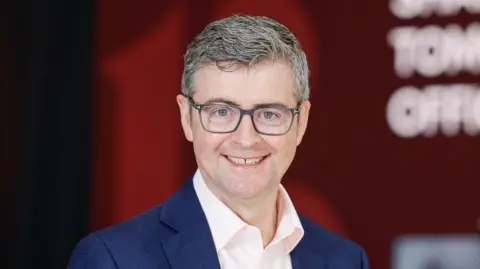
Brendan Mooney was speaking as Kainos announced a record half-year performance with a pre-tax profit of £36m on sales of £269m.
The company recently won a £111m "digital borders" contract with the Home Office to be delivered over the next four years.
Mooney said there were "parallel conversations" on AI with "buzz and excitement" about its capabilities on one hand and the reality of deploying it in large organisations on the other.
He told BBC News NI: "The hardest thing we do as a company is to get an AI system live and to keep it live because an AI system runs on top of a model, that model drifts, either through changes to the model or changes to how the model interprets the data."
He said that clients operating in regulated or sensitive areas like healthcare or defence are "super cautious" about how AI will be used in their organisations.
Mooney said that Kainos' internal spending on AI has doubled in the last year partly due to greater use across the business as well as an increase in the prices charged by the major AI firms.
Could AI replace junior staff?
He added that the productivity gains from using in AI in software development has been "well proven" and is generating value for the business.
Those productivity gains have led to concerns that AI is costing jobs across a variety of professions such as software development and business consulting.
Mooney rejected as "one-dimensional" the view that AI tools could replace the need for junior staff.
He said that while, historically, graduates were asked to do simple tasks, they can - and should - be asked to do more complex work.
"Yes, they need time to build their skills and knowledge, and judgement is ever-increasingly an important part of what we do today.
"But I just think it shows limited imagination if you're saying that all graduates are good for is doing something very simple."
He expects more than 200 people to join the business this year through graduate and school-leaver programmes which he called "our strongest ever graduate intake".
The company currently employs almost 4,000 people across its global operations with almost 1,400 of them in Northern Ireland.
It is currently developing a new HQ building in the centre of Belfast.