Floating bus stop report finds they pose 'low risk'

 National Federation of the Blind
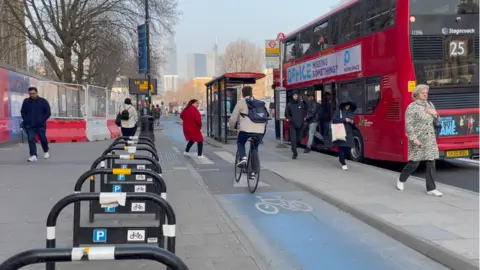
A Transport for London (TfL) report on floating bus stops that says they pose "very low risk" to pedestrians has angered disability campaigners.
In one of three new reports released on Friday, TfL admitted floating bus stops might deter older and disabled people from using public transport, but said this proportion was "not statistically significant".
A floating bus stop, also known as a bus stop bypass (BSB), is a road layout where a dedicated cycle lane runs behind the passenger waiting area, separating it from the main pavement.
Sarah Gayton, of the National Federation of the Blind (NFB), said BSB's were "absolutely abhorrent" and "not fit for purpose for all people".
More than 290 organisations representing blind, deaf, disabled, partially sighted, and elderly people previously wrote to the prime minister, expressing concerns about the accessibility and safety of floating bus stops and demanding their removal from road infrastructure.
Last year the government announced a pause on the rollout of the Shared Use Bus Border (SUBB), where the cycle lane runs across the front of the bus stop, but did not stop the future construction of BSBs.
In its new reports, TfL said it was "rare" for a pedestrian and cyclist to "interact" at a floating bus stop.
It found there had been only five pedestrian casualties involving cyclists and one involving an e-scooter over a three-year period analysed, compared with 11,400 pedestrians injured by motorists in the same period.
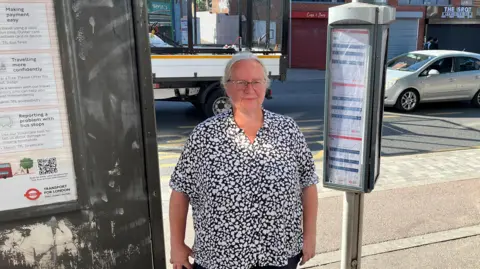
However, Gayton said the true figure of injuries was actually far higher because many incidents at floating bus stops went unreported.
"What we have is people not telling the police or reporting if they've been hurt, because they don't know who's at fault," she said.
Gayton herself has filmed several collisions, five of which occurred at the same floating bus stop near St Thomas' Hospital in 2024.
The new reports do not cover this time period, but instead compare data from March to August 2018 and March to August 2023 - before BSBs had been implemented and after.
Erik Matthies, who has sight loss and is the Royal National Institute of Blind People's (RNIB) policy lead for travel and transport, said the group's research suggested that 40% of blind and partially sighted people avoided floating bus stops entirely.
"Low injury reports don't tell the whole story - there is no safe and accessible way for people like me to cross the cycle lane to and from a bus stop, and today's review from TfL does not address that," he said.
Earlier this month, the London Assembly called for a pause in the installation of floating bus stops, saying the designs had left some people "fearing for their safety".
London TravelWatch, the capital's transport watchdog, also said it wanted a halt in the creation of any new BSBs.
TfL said it had paused bus stop designs that required passengers to step directly into a cycle lane, but that work was continuing on three floating bus stops where cyclists passed behind the bus stop.
Christina Calderato, TfL's director of transport strategy, said that everyone should be "able to travel safely, confidently and independently around London".
"These reports provide important evidence about bus stop bypasses, the concerns that some people have raised, and the action we are taking with partners to improve safety and accessibility for all users."
Will Norman, London's walking and cycling commissioner, said the mayor's office was "committed to enabling safe and sustainable travel across the capital for everyone".
"It's encouraging to see data confirming that the risk of bus stop bypasses to pedestrians is extremely low, but also that TfL remains committed to making this infrastructure work for everyone."
Listen to the best of BBC Radio London on Sounds and follow BBC London on Facebook, X and Instagram. Send your story ideas to hello.bbclondon@bbc.co.uk