UK national tests positive for Ebola virus in DR Congo

 EPA
A British national who is in the Democratic Republic of Congo has tested positive for Ebola, the UK government has confirmed.
A spokesperson said the UK "has well-established procedures for dealing with cases like this" and that the risk to the public remains low.
It is the first confirmed case of a UK national contracting Ebola during the most recent outbreak of the rare but deadly virus in DR Congo, which has so far led to more than 5,000 deaths.
The Foreign Office did not confirm whether the patient would be brought back to the UK for treatment, though a UK resident who was exposed to the virus in July was flown back for medical attention, as have previous nationals infected abroad.
Reuters news agency reported the most recent patient is a healthcare worker and would be brought to the UK, citing an internal document BBC News has not seen.
A UK government spokesperson said: "The UK has well-established procedures for dealing with cases like this, and those processes have been activated.
"Further information will be shared in due course as appropriate. The risk to the UK public from Ebola remains low."
Imported Ebola cases are extremely rare in the UK and have resulted in no deaths.
There have only been four confirmed cases of the virus in the UK - one, in 1976, resulting from a laboratory incident, and three involving health workers who were responding to an outbreak in West Africa between 2014 and 2015.
There have been more than 10,000 confirmed cases since the recent outbreak in DR Congo started in May, which has grown to become the second most deadly recorded spate of infections, behind the outbreak in West Africa.
It has since become the deadliest in the country's history, with a fatality rate of 48.6% reported at the end of last month.
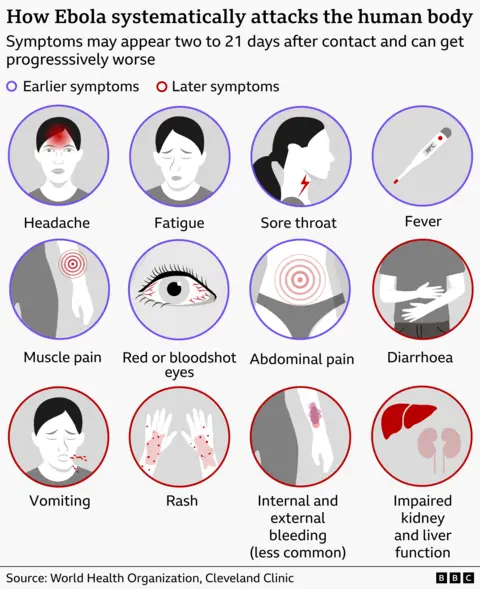
Ebola can result in serious illness and death. Early symptoms include vomiting and diarrhoea but it can progress to organ failure and internal bleeding.
The virus spreads from one person to another by contact with infected bodily fluids such as blood or vomit.
The ongoing outbreak centred on DR Congo is fueled by the Bundibugyo variant of the virus, for which there is no approved vaccine.
Cases have also been confirmed in Kenya, Nigeria and Uganda.